
How Timenow’s Monte Carlo Simulation Framework for Industrial Projects anticipated a targeted action plan that prevented a three‑month delay and a 12% cost overrun.
with Fabio Machado
At Timenow we recently applied Monte Carlo Risk Analysis during the approval phase of a manufacturing site expansion project in Michigan, proving the importance of risk management from the beginning of the project.
Applying the Timenow methodology for Monte Carlo simulations, the team built and delivered a Risk Management chapter for the Project Execution Plan, enabling the client to navigate scenarios and anticipate problems.
Monte Carlo risk analysis is common in the finance world—but it’s used in many other sectors because of its ability to run thousands of “what if” scenarios using multiple variables. This powerful statistical tool gives organizations like EPCs, owner-operators, and other industrial organizations a solid understanding of how to plan projects that stay on time and on budget.
THOUSANDS OF MODELS TO PREDICT RISK
For capital projects, Monte Carlo risk analysis uses rigorous statistical modeling to mitigate risk before it affects delivery. In fact, many Monte Carlo models use a front-end load methodology that starts to evaluate risk as soon as a project is conceptualized. Once the basic engineering is complete, Timenow creates a model of as many project risks as possible—everything from equipment importation and postponed shipping to union strikes and weather conditions. Using Primavera Risk Analysis, the model will run hundreds or even thousands of simulations and determine the risk level.
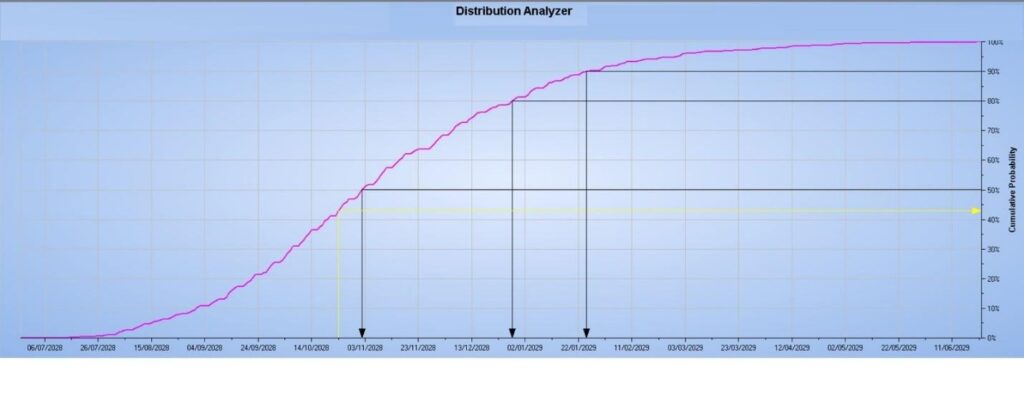
Once results are converged to assess risk, they can be compared to the master project schedule. The simulation will spell out the probability of meeting the timeline, as well as how much the operators need to allocate for time and budget. Deliverable results include risk registers, probability distributions, S-curves, contingency recommendations, and executive risk reports. Project owners can then make informed decisions on whether to adapt original milestones, revise their budget, or adjust their timeline to account for potential risks.
A COLLABORATIVE APPROACH
Timenow uses certified, high-level specialists with expertise in your industry—pulp and paper to steel, food and beverage to energy—to perform this critical risk analysis. This specialist will work across all relevant areas of the organization, including procurement, engineering, maintenance, scheduling, and finance, to define and categorize risks. This collaboration is essential to a successful understanding of project risk.
In partnership with your organization, Timenow will execute more than just a simulation. It will complete a full analysis from beginning to end, including risk reports, probability distribution, and recommendations on how to put results into action. Along with rigorous statistical modeling, collaboration is key to gaining early visibility into the most probable risks to a project, allowing organizational leaders to form contingencies and have greater confidence in planned funding.
PROCESS AND BENEFITS
As part of this collaborative process, Timenow will:
- Facilitate workshops with relevant stakeholders to identify key risks by better understanding operational cost and causes of uncertainty
- Develop a probabilistic model using Monte Carlo simulation in Primavera Risk Analysis
- Run thousands of iterations through this model to generate and rank core risk drivers
- Create executive-ready risk reports and S-curves and recommending defensible contingencies
By tailoring the process to your unique organization, Timenow does much more than simply run a simulation. It works with team leaders to get a full understanding of a specific project and how the organization anticipates risk, then uses the modeling data to make specific recommendations for a successful execution–on time and on budget.
Key benefits include:
- Exposing cost risk before funding is locked in
- Revealing true completion dates based on hard data
- Prioritizing risk by ranking probability, improving funding confidence
- Alignment across teams through workshops on cost, schedule, and delivery
- Creating an auditable risk trail for stakeholders
- Accelerating decision-making based on data-driven forecasting
CONCLUSION FROM MOST RECENT CASE
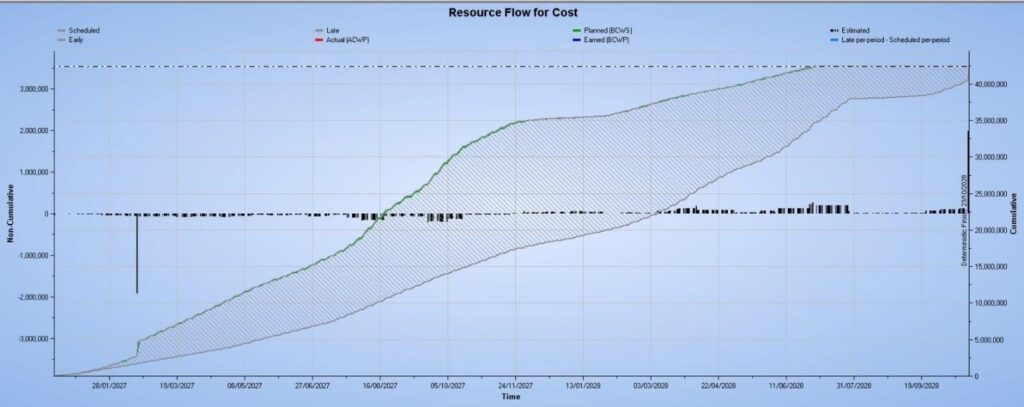
The latest application of Timenow’s Monte Carlo Simulation Framework enabled the team to identify the project’s main uncertainty windows and prioritize the risks most likely to impact schedule and cost. Key risks—such as long‑lead material procurement and exposure to weather‑related delays—were analyzed, mitigated, and incorporated directly into the Project Management Plan. These insights strengthened the project’s risk manual and provided clear, defensible contingency guidance for decision‑makers.
FULL SERVICE, NOT JUST MODELING
Timenow has helped facilitate more than 20,000 projects. This expertise, combined with a partnered approach to risk management, creates a full-service experience that sets your project up for success before it’s off the ground.
Interested in working with Timenow on your next project? Contact us today to learn more about how your industrial operation can benefit from our collaborative approach to risk management through proven methodologies.


